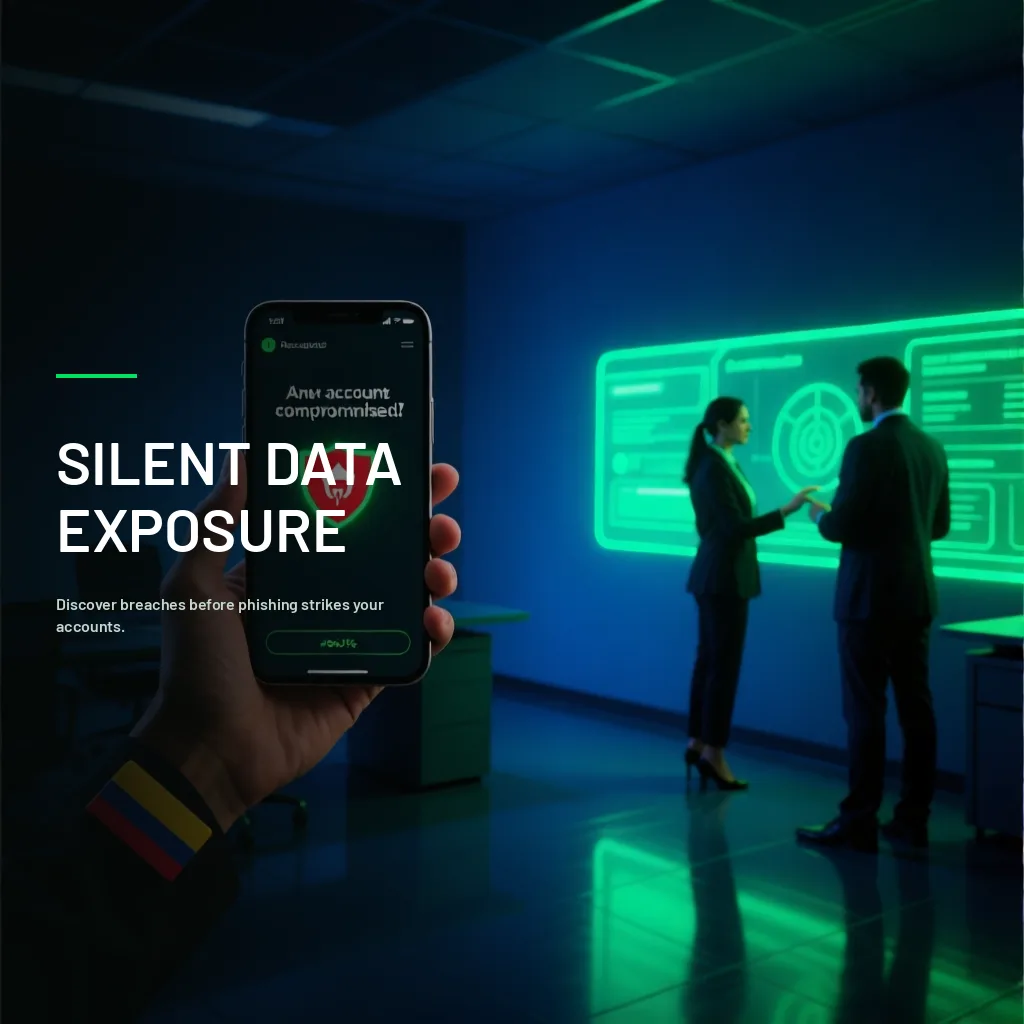
Most people whose personal data ends up circulating in a security breach don't find out from the responsible company — they find out months later, when they start receiving surprisingly specific phishing attempts, or when someone tries to access one of their accounts using a password they'd only ever used on a service they'd forgotten they used. Reported data breaches have grown rapidly in recent years, with millions of email records exposed in just the latest reported period — and most affected people still don't know it.

Anatomy of the attack described in the article.
Why This Matters More Than It Seems
A leaked email on its own seems minor, but it rarely travels alone. Data breaches usually expose combinations of information — email, password (sometimes in plain text, sometimes hashed but potentially crackable), phone number, address — that together give an attacker enough material for targeted phishing attempts far more convincing than a generic email, or for direct access attempts on other accounts where the victim reused the same password.
How to Check If Your Data Was Exposed
Specialized, free services exist that let you enter an email address to check whether it appears in known, publicly documented breach databases. These services don't access your accounts or require passwords — they simply compare your email address against already-reported and cataloged breach records. It's worth checking periodically, not just once, since new breaches get documented continuously.
What to Do If You Discover Your Data Was Leaked
Immediately change the password for the affected service, and for any other service where you reused the same password — this is exactly the risk password reuse amplifies.
Enable multi-factor authentication on any important account that doesn't already have it, prioritizing authenticator apps over SMS when possible.
Closely monitor your financial accounts over the following weeks, paying special attention to access attempts or transactions you don't recognize.
Prepare for an increase in targeted phishing attempts, since leaked data is often used specifically to make those emails more convincing — check our guide on how to spot a phishing email if you notice an unusual increase in suspicious messages.
What This Means If You're a Business, Not Just an Individual
If your business was the source of the leak — meaning your customers' or employees' data was what got exposed — the obligations go far beyond recommending good practices to those affected. Colombia's Habeas Data Law requires reporting the incident to the Superintendency of Industry and Commerce when personal data is compromised, and our guide on when reporting a cyberattack is legally required details exactly those timelines and processes.
Why Password Reuse Is the Real Risk Multiplier
Most of the real damage a data breach causes doesn't come from the leak itself, but from password reuse across services. If your password for a forum you stopped using years ago is the same one you use for your main email, a breach at that forum gives an attacker potential access to your email — and from there, to practically everything else through password recovery. A password manager that generates unique credentials for each service eliminates this risk at the root.
Frequently asked questions
How often should I check if my data has been leaked?
It's worth doing periodically, every few months, since new breaches that may include your information get documented continuously without you knowing right away.
If my email shows up in a breach, does that mean my account was hacked?
Not necessarily directly — it means your information was exposed in some service that suffered a breach. The real risk depends on whether you reused that same password elsewhere.
Are businesses required to notify me if my data was leaked?
In Colombia, under Law 1581, businesses responsible for processing personal data have notification obligations for security incidents that compromise that information.
Is changing my password enough after a leak?
It's the essential first step, but combining it with multi-factor authentication and avoiding password reuse across services offers much more complete protection.
Controls and monitoring that stop the attack.
Let's talk
Knowing your data was leaked is only the first step — acting fast on that information is what actually reduces the risk. If your business needs to assess its exposure or respond to a data breach incident, at T.I. RESCUE we offer both 24/7 incident response and compliance consulting for both fronts. Does your business handle customer data and want to assess its real exposure? Let's talk.
Contact usYou may also like


Comments (0)
Be the first to comment.