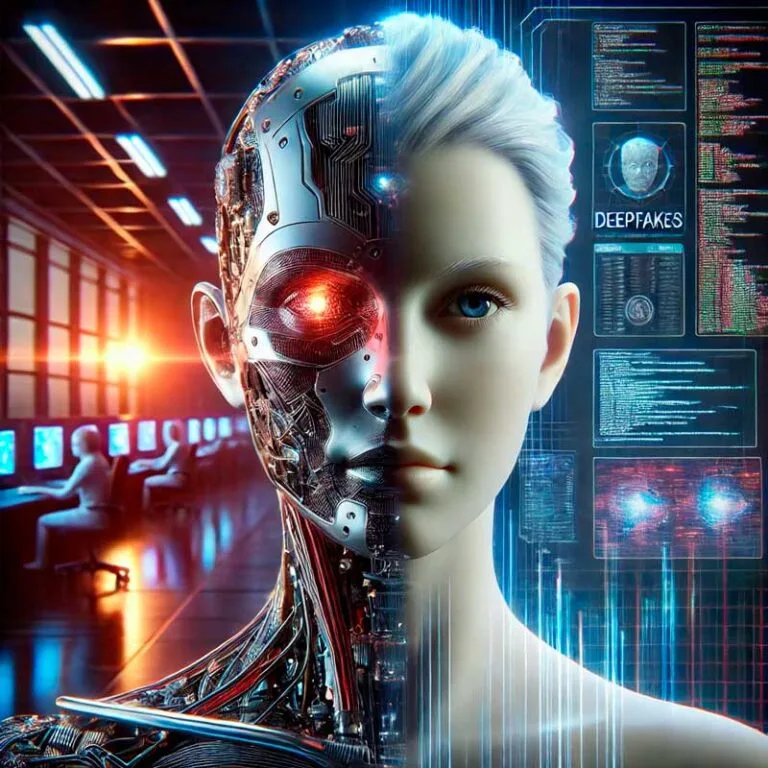
Artificial intelligence (AI) has revolutionized multiple industries, but it also poses significant challenges. In this article, we explore the main risks of AI and how companies can mitigate them.
Free tool: AI Risk Classifier. See if your use case is high-risk under the EU AI Act or Colorado law and what it would require.
1. Privacy and Security: How Do AI Systems Protect Data?
One of the biggest risks of artificial intelligence is the vulnerability of personal data. AI systems collect and process enormous volumes of information, making them attractive targets for cybercriminals. Some of the dangers include:
• Leaks of confidential information. • Misuse of personal data. • Manipulation of information for social engineering attacks.
Solution:
Companies must implement data encryption, strict access controls, and periodic audits to ensure information security.
2. Cybersecurity and Threats: AI as an Attack Tool
Cybercriminals have begun using AI to design more sophisticated attacks, such as advanced phishing and the use of deepfakes. Some risks include:
• Automation of cyberattacks. • AI used to exploit vulnerabilities in networks and systems. • Identity impersonation through deepfakes.
Solution:
Organizations must invest in AI-based cybersecurity tools to detect and mitigate threats in real time.
3. Unemployment and Automation: Is AI Replacing Humans?
The automation of tasks through AI is affecting the labor market, with sectors such as manufacturing, customer service, and logistics seeing a decrease in demand for human employees. Some of the effects include:
• Replacement of traditional jobs. • Greater dependence on advanced technological skills.
Solution:
It is essential to retrain and upskill the workforce to adapt to an environment where AI is predominant.
4. Bias and Discrimination in Artificial Intelligence
AI algorithms can contain biases that result in discriminatory decisions, affecting sectors such as hiring, bank credits, and surveillance.
• Algorithms with racial or gender biases. • Lack of transparency in AI decision-making.
Solution:
Companies must develop more equitable and transparent AI models, using diverse datasets and bias testing.
5. Technological Dependence and Lack of Human Control
As AI becomes more integrated into our daily lives, dependence on automated systems increases, which can lead to problems such as:
• Decisions made without human supervision. • Loss of critical skills due to automation.
Solution:
It is fundamental to maintain the human factor in critical processes and establish supervision protocols to avoid excessive dependence on AI.
6. Disinformation and Manipulation: Deepfakes and Fake News
Advances in AI have facilitated the creation of false content, such as deepfakes and fake news, which can influence public opinion and political stability.
• Creation of misleading content. • Manipulation of public opinion through bots.
Solution:
Develop tools for detecting false content and promote digital literacy in society.
7. Existential Risks: Could AI Get Out of Control?
Although we are still far from fully autonomous AI, experts warn about the risk of AI systems evolving without human control, which could lead to dangerous situations, such as:
• Use of AI in autonomous weapons. • Scenarios of superintelligent AI outside human control.
Solution:
Strict regulation and ethics in AI development to ensure its safe and responsible use.
Conclusion
While artificial intelligence offers numerous benefits, it also presents significant challenges that must be addressed with effective mitigation strategies. The key is to develop and implement AI ethically, with adequate controls and constant human supervision.
Is your company ready to face the risks of AI?
If you need advice on cybersecurity and AI management, contact our experts to strengthen your business protection.
At T.I. RESCUE, we offer specialized services to protect organizations against these threats. Contact us to strengthen the security of your data and prevent targeted attacks.
🚀 Contact us now!
Topics that might interest you:
• What is a vulnerability • How to generate secure passwords • IT company in Medellín
Subscribe to Our Blog: Stay up to date with the latest news and tips in cybersecurity. Subscribe now.
Want to put your company's AI under control?
Learn about our ISO 42001 AI governance service: diagnosis, testing, and closure plan with evidence.
View the serviceYou may also like
Responsible AI Audit: The Guide for Companies Implementing Deep Learning and Generative Models

AI Security in Enterprises: How Data Leaks Occur When Using ChatGPT/Copilot-Type Assistants (and How to Prevent Them)
Your AI stack as a human body: why stopping at LLM + RAG leaves it without an immune system
Comments (0)
Be the first to comment.