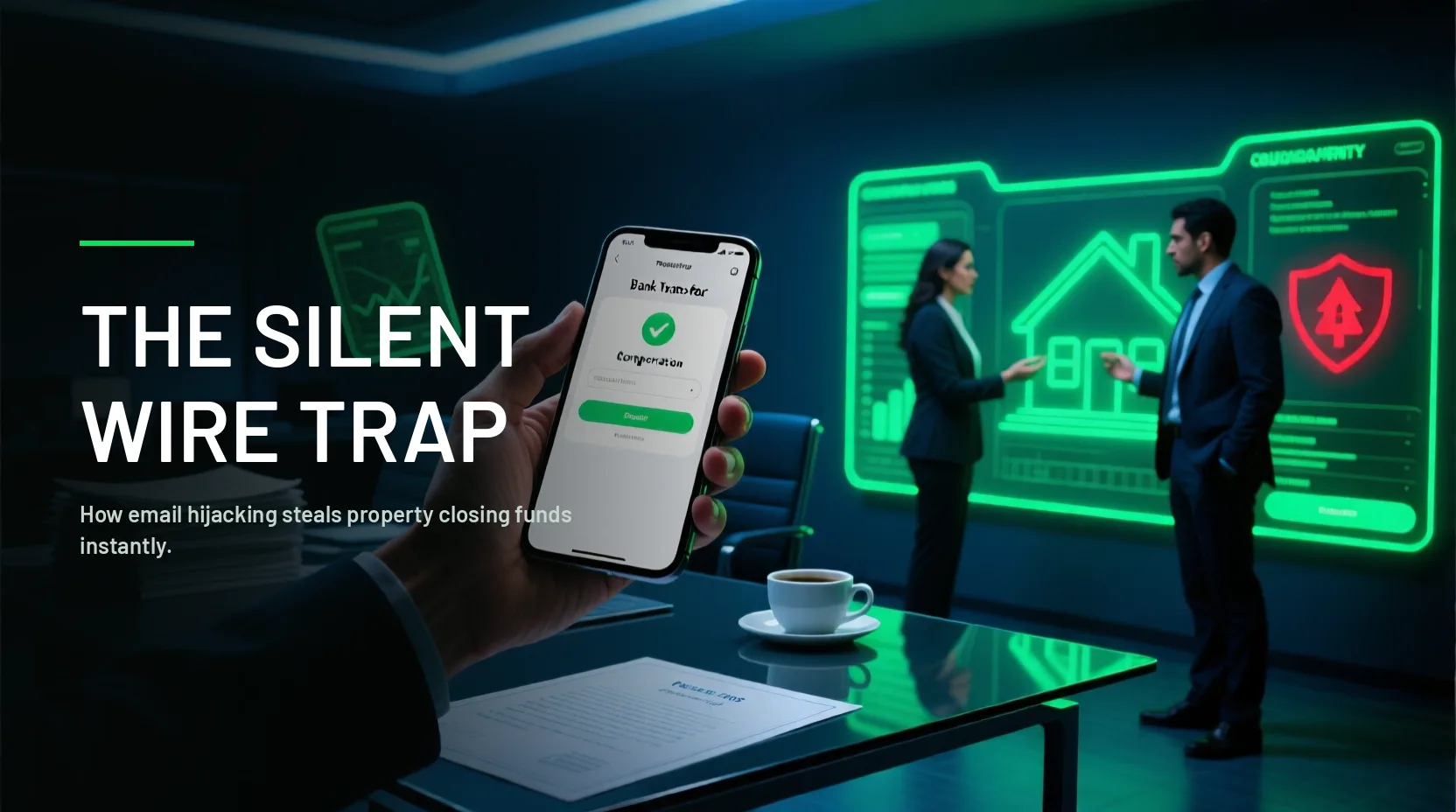
A real estate agency is coordinating the closing of a property sale. The buyer receives, apparently from the same email thread they've been using to coordinate the entire process, instructions to transfer the down payment to a new bank account due to "internal administrative changes." The buyer transfers the money — sometimes amounts representing a lifetime's savings — without suspecting anything, because the email arrived exactly at the expected point in the process, with the usual tone and format. The money disappears, and neither the agency nor the buyer realizes it until someone asks why the payment never arrived in the real account.
Why Real Estate Is Such an Attractive, Overlooked Target
Real estate transactions combine three factors that make them extraordinarily attractive for fraud: very high dollar amounts compared to typical business transactions, processes involving multiple parties over email (buyer, seller, agency, notary, financial institution), and an industry that, compared to sectors like finance, has historically invested far less in cybersecurity — precisely because it doesn't always see itself as a technology target.
This combination is exactly the same pattern we describe in our guide on CEO fraud / BEC, but applied to a context where the ultimate victim is usually an individual, without the legal resources or insurance a large company would have available to mitigate the loss.
How These Attacks Specifically Operate in the Sector
Compromise of the agency's or notary's email, where the attacker gains access to the real account through phishing or leaked credentials, then monitors active sale conversations waiting for the exact moment to insert fraudulent payment instructions.
Look-alike domain impersonation, creating an email address nearly identical to the real agency's or notary's (with a swapped letter, for example), and joining the email thread at a critical point in the process.
Monitoring public property listings, where the attacker identifies ongoing transactions through public real estate portals and directly contacts potential buyers, posing as the agent or agency.
Why Timing Makes This Fraud So Effective
Unlike a generic phishing email arriving without context, these attacks are deliberately timed to the exact moment the victim expects to receive payment instructions — right before closing, when time pressure and the natural anxiety of a high-value transaction reduce the likelihood the victim will stop to carefully verify.
Controls the Sector Should Implement
Mandatory phone verification for any bank detail change, using an already-known, previously verified number, never the one appearing in the email with the new instructions — the same out-of-band verification principle that applies against any BEC variant.
Multi-factor authentication on all email accounts of staff involved in coordinating transactions, significantly reducing the risk of a legitimate account being directly compromised.
Proactively communicating to buyers and sellers that the agency will never change bank details by email without additional phone verification, setting that expectation from the start of the process.
Monitoring for look-alike domains, to catch early if someone has registered a domain designed to impersonate the agency in a targeted attack.
**Specific training on recognizing phishing and spear phishing** for all staff handling communication related to high-value transactions.
What Buyers and Sellers Can Do to Protect Themselves
Always confirm any payment instruction or bank detail change with a phone call to the number you already knew before the transaction began, never the one appearing in the email with the new instructions. Be wary of any sudden change in payment details, especially arriving with urgent language near the closing date.
Frequently asked questions
Does this type of fraud only affect sale transactions, or rentals too?
While sales represent the highest amounts and therefore the greatest attraction, rental deposits and other lower-value real estate transactions have also been targeted by similar variants of this fraud.
Who's legally liable if this fraud occurs, the agency or the buyer?
It depends on the specific circumstances of the case and how reasonable each party's verification measures were — which is why it's so important for agencies to establish and communicate clear verification protocols from the start of the process.
How do I know if the email with "new payment instructions" is legitimate?
Never assume based on the email's content alone. Call directly, using a number you already had before this specific communication, to verbally confirm any change before transferring any amount.
Is it possible to recover the money if the fraudulent transfer already happened?
It depends heavily on how fast you react. Contacting the issuing bank immediately to try to stop or reverse the transfer offers some chance in the first hours, but the probability of recovery drops quickly over time.
Let's talk
High-value real estate transactions deserve the same verification rigor as any significant business transfer. At T.I. RESCUE we help real estate agencies and notaries implement these controls within our social engineering defense service. Does your agency have clear verification protocols for transactions? Let's talk.
Contact usSet this site as a preferred source on Google
You may also like


Comments (0)
Be the first to comment.