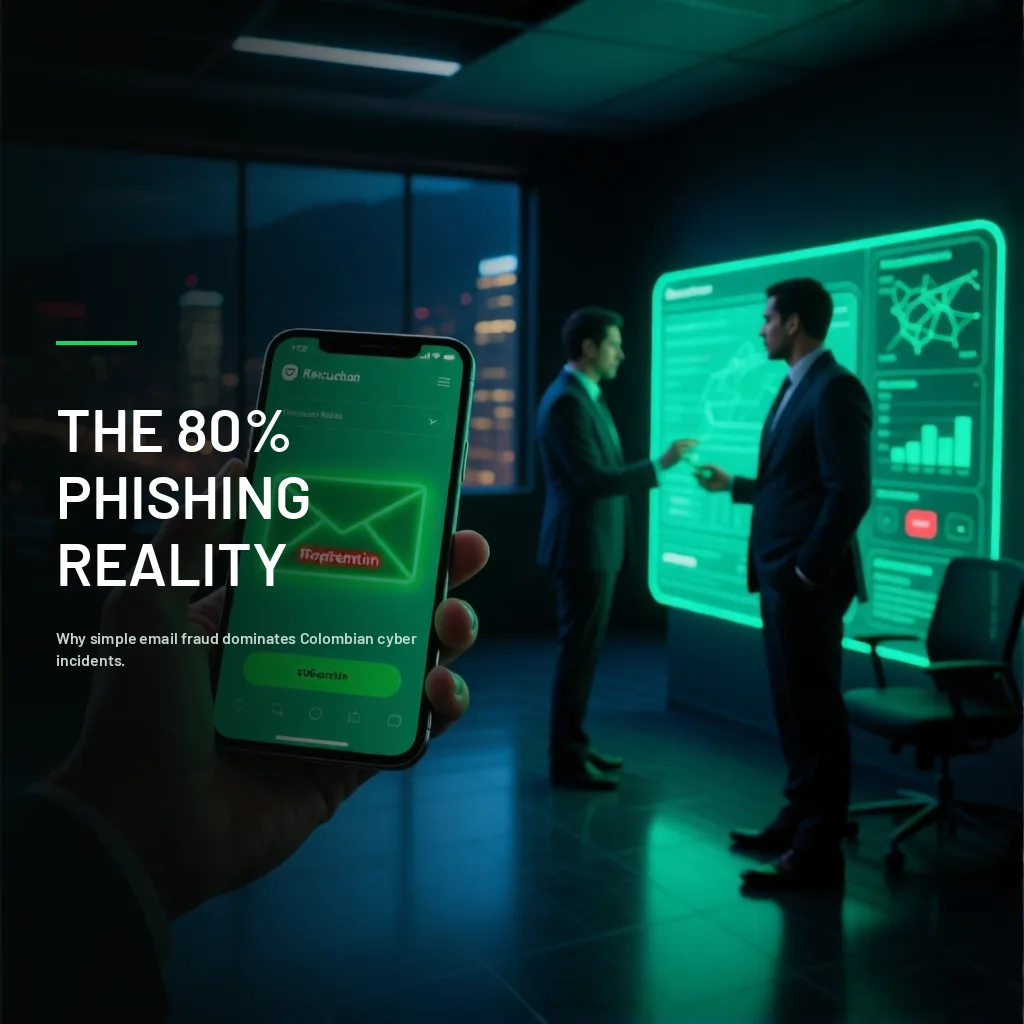
It's tempting to picture sophisticated cyberattacks: zero-day exploits, advanced hacking tools, attackers with exceptional technical skill. The reality behind most incidents in Colombia is far less cinematic. According to figures from the Ministry of Information and Communications Technology, fraud — driven mainly by phishing and unauthorized use of email accounts — accounts for close to 80% of incidents reported in the country over the past two years. You don't need a sophisticated exploit when a well-designed email and one employee clicking without a second thought will do.
Why Phishing Still Works After All These Years
If phishing is such a well-known technique, why does it remain so effective? The answer has less to do with technology and more to do with human psychology. Phishing doesn't exploit a software vulnerability — it exploits trust, urgency, and routine. An email that looks like it's from the bank, with the right logo and an urgent tone about "suspicious activity on your account," triggers an emotional response that overrides critical thinking, especially when the person is busy, distracted, or checking email on their phone between other tasks.
The Variants Showing Up Most in Colombia
Generic phishing — mass emails with obvious spelling errors — still exists, but it accounts for an increasingly smaller share of the real problem. The variants actually causing incidents today are far more targeted:
Emails impersonating Colombian banks and financial institutions, asking to "verify" account information over supposedly suspicious activity — the hook that consistently drives the most clicks because it directly appeals to the fear of losing money.
Emails impersonating real vendors or clients of the company, requesting a bank account change for a payment — a variant that has caused significant losses in business transactions.
Messages impersonating government agencies or public utilities, exploiting processes most people are already used to handling online.
Variants that no longer arrive only by email: smishing (via SMS) and vishing (via phone call) are growing specifically because many security filters were designed with only email in mind.
The Underlying Problem: Phishing Is the Door, Not the Destination
A successful phishing email is rarely the entire attack — it's the entry point that enables something bigger. Credentials stolen through phishing are frequently the first step toward a ransomware-as-a-service attack, toward unauthorized access to systems protected under Law 1273, or toward outright theft of funds through fraudulent transfers. Treating phishing as "just a suspicious email" seriously underestimates what it actually represents within the full chain of an attack.
What Actually Reduces the Risk
Technology alone doesn't solve the phishing problem, because phishing is specifically designed to evade technology by appealing to the human factor. The measures that consistently show real impact combine both fronts:
Frequently asked questions
Why does phishing remain so common if most people already know what it is?
Knowing what phishing is in theory doesn't always translate into recognizing it under pressure, distraction, or when the email is well-designed and personalized. General awareness doesn't replace recognizable practice built through real simulations.
Shouldn't modern email filters block most of these attempts?
They block a significant share, but no filter is perfect, and attackers constantly adjust their techniques to evade the most common ones. Defense can never rely on a single layer.
How common is spear phishing targeted at specific employees, versus generic phishing?
Increasingly common, especially against employees with access to financial or administrative systems — this is what's known as spear phishing, and it's usually better researched and personalized than traditional mass phishing.
How long does it take to effectively train a team against phishing?
It isn't a one-time event. Effective training is ongoing, combining initial instruction with periodic simulations that keep vigilance active over time, not just right after a single training session.
Let's talk
Phishing remains the root cause behind most serious cybersecurity incidents, and it deserves the same technical seriousness as any other threat. At T.I. RESCUE we work on [social engineering defense](https://tirescue.com/en/ataques-de-ingenieria-social/) — from simulations to real training — and we offer [24/7 incident response](https://tirescue.com/en/respuesta-ante-incidentes-247/) if a phishing attack has already escalated into a larger compromise. Want to assess how prepared your team really is? [Let's talk](https://tirescue.com/en/contacto-ti-rescue/).
Contact usYou may also like


Comments (0)
Be the first to comment.