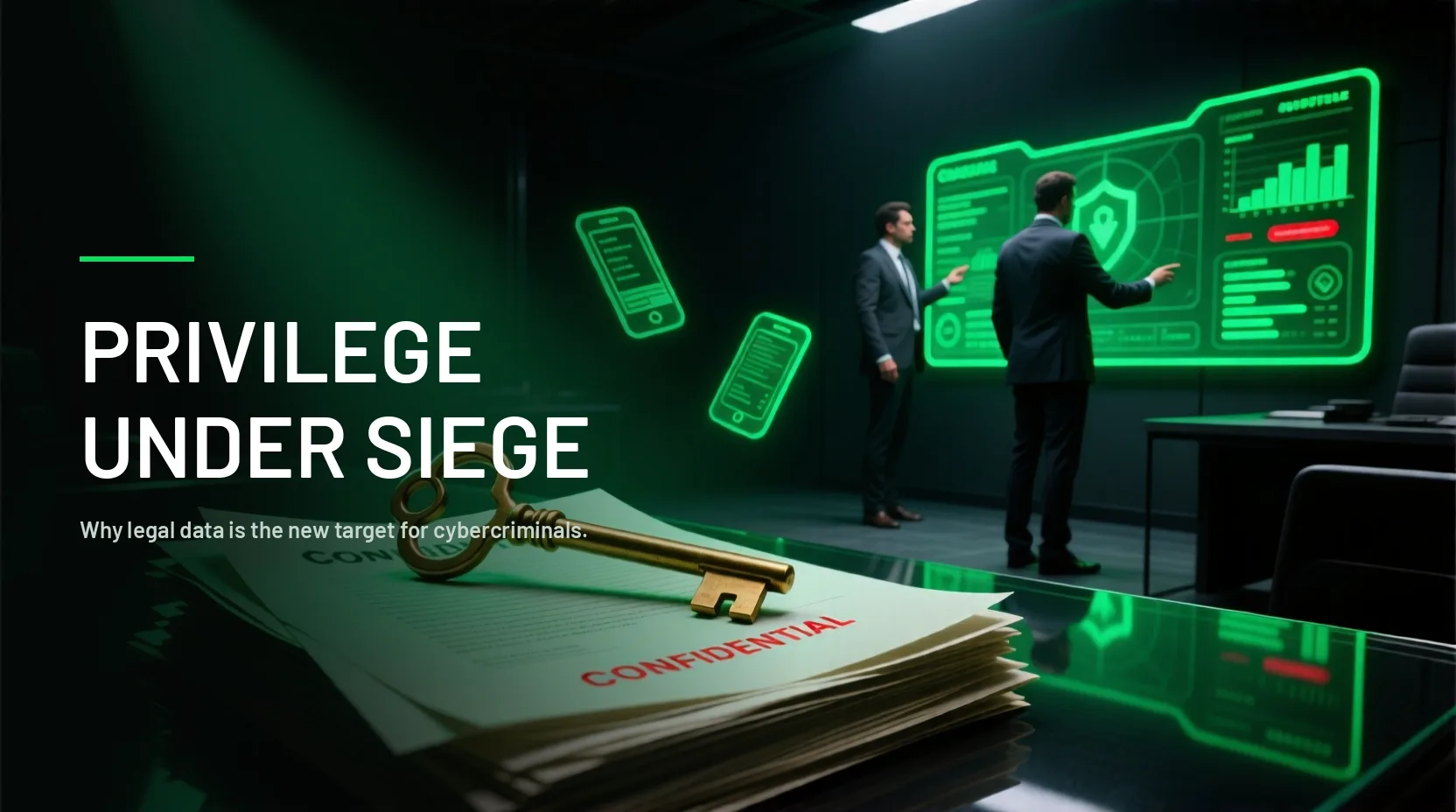
A law firm handles, in the normal course of its work, information no client would want exposed: litigation strategy, confidential negotiation terms, financial details of mergers and acquisitions before they go public, communications protected by attorney-client privilege. That concentration of sensitive information, combined with security controls that historically haven't been a priority in the legal industry, makes law firms a particularly attractive target — and one particularly underestimated by firms themselves.

Anatomy of the attack described in the article.
Why Law Firms Are an Attractive Target
An attacker who compromises a law firm doesn't just gain access to the firm's own information — they potentially gain access to confidential information belonging to all its clients, including companies that individually would have much more robust defenses. This makes the firm an indirect entry point toward higher-value targets, a pattern similar to what we describe in our guide on vendor management under Circular 007 — the weakest link in the chain determines the real risk for everyone connected to it.
The nature of legal work also creates real time pressure: leaking litigation strategy before a hearing, or negotiation terms before closing, can have consequences far beyond reputational damage, which makes law firms seen as targets with a high likelihood of paying quickly under an extortion threat.
Risk Vectors Specific to the Legal Sector
Email as the central work tool, since much of the communication with clients and counterparties happens through this channel, making phishing and CEO fraud / BEC particularly relevant threats — a fake email requesting a bank detail change for a settlement payment can cost significant sums.
Highly sensitive documents shared with multiple parties, including clients, counterparties, expert witnesses, and other external entities, each representing an additional point of exposure outside the firm's direct control.
Mobile devices and remote work by attorneys, who frequently access confidential information from varied locations and networks — hearings, client meetings, travel — expanding the attack surface beyond the office.
Time pressure in judicial processes that can lead to skipping standard security checks when a procedural deadline looms, a pattern attackers know and deliberately exploit.
Controls a Law Firm Should Prioritize
Encrypting sensitive documents both at rest and in transit, especially those protected by attorney-client privilege, ensuring that even if a device is lost or compromised, the information remains inaccessible.
Mandatory multi-factor authentication on email and document management systems, since these are the central work tools and the most likely target of a directed attack.
Out-of-band verification for any bank detail change related to settlement payments, fees, or significant transfers — the same control we describe in our guide on CEO fraud, particularly critical in a sector where high-value transfers are routine.
Clear policies for handling information on mobile devices and remote work, including remote wipe capability in case of loss or theft of a device with access to confidential information.
Specific training for legal teams on recognizing targeted threats, since attorneys and their support staff are frequently the target of spear phishing designed specifically against the sector.
The Professional Responsibility Behind Cybersecurity
Beyond the commercial risk, many legal professional ethics codes include explicit or implicit obligations to protect client information confidentiality with reasonable measures — which makes cybersecurity, in practice, part of the firm's professional responsibility, not just an optional operational consideration.
Frequently asked questions
Are small firms also targeted by these attacks?
Yes. Firm size doesn't determine whether it handles valuable information — small firms working with high-profile clients or on significant transactions can be just as attractive as large firms.
What specific information should firms encrypt?
Any document protected by attorney-client privilege, sensitive financial information from ongoing transactions, and communications related to active litigation should have the highest level of protection available.
How does remote work affect a firm's security?
It significantly expands the attack surface, since confidential information is no longer limited to the office's controlled network — it requires specific policies and technical controls for devices and connections outside the traditional environment.
Can an attack on a firm legally affect its clients?
Yes, potentially. If a client's confidential information leaks through a firm breach, there can be legal and reputational consequences both for the firm and, indirectly, for the affected client.

Controls and monitoring that stop the attack.
Let's talk
Attorney-client privilege demands the same level of technical rigor as any other highly sensitive information. At T.I. RESCUE we work with law firms on cybersecurity audits and specific protection for confidential communications. Has your firm formally assessed its exposure to these risks? Let's talk.
Contact usSet this site as a preferred source on Google
You may also like



Comments (0)
Be the first to comment.