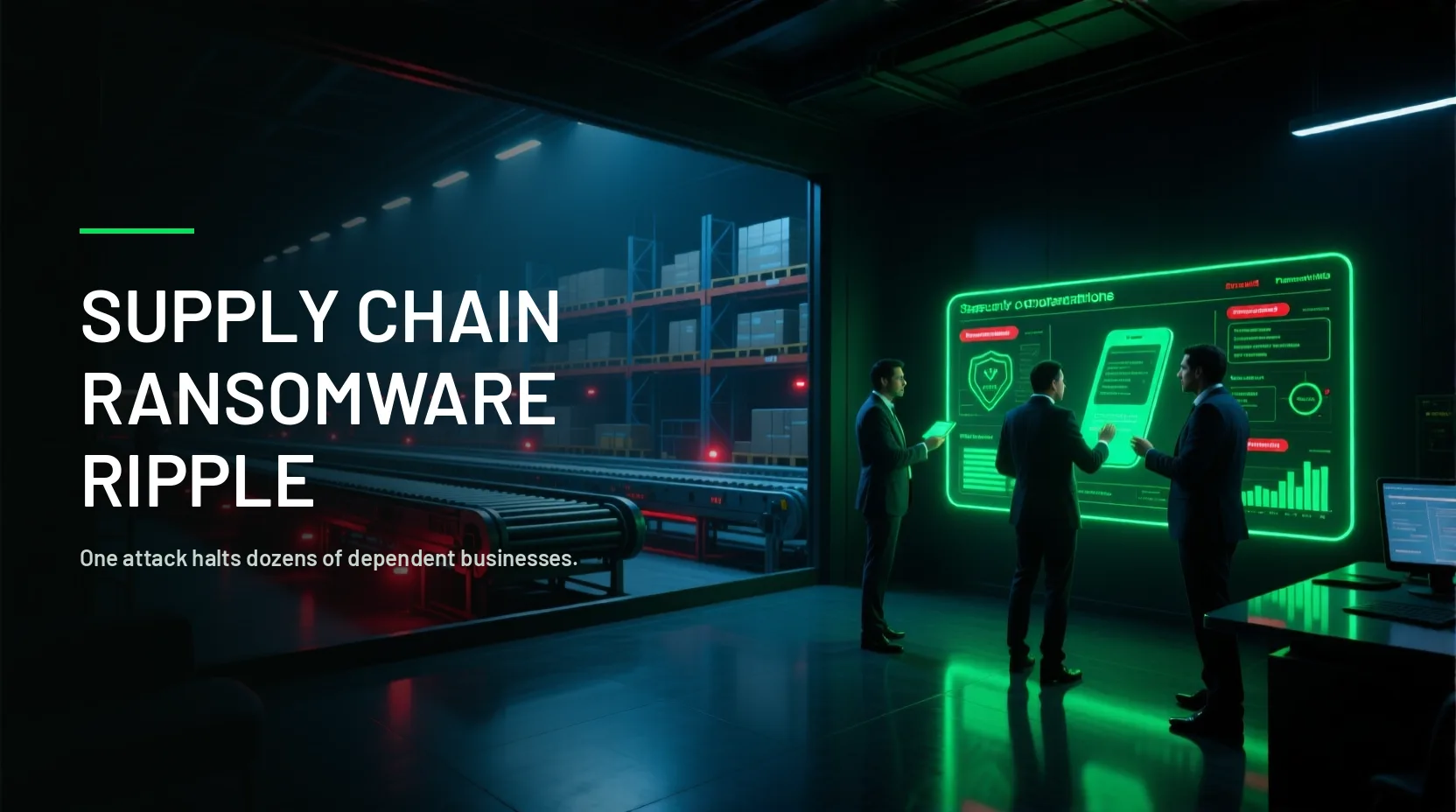
A ransomware attack on a single transportation company doesn't just halt that company — it can halt deliveries for dozens of businesses that depended on it to move goods. Logistics and transportation have a characteristic that makes them a particularly disruptive target: they're the connection point between multiple businesses, meaning a single successful attack can have a much broader ripple effect than the direct damage to the attacked company.
Why This Sector Has Grown More Vulnerable Over Time
The digitalization of logistics — real-time tracking systems, fleet management platforms, automated integrations with customers and vendors, IoT devices in vehicles and warehouses — has brought real efficiency, but has also considerably widened the attack surface of an industry that traditionally operated with more manual, isolated processes.
Risk Vectors Specific to the Sector
Compromised fleet management and tracking systems, which, beyond direct operational risk, can expose sensitive information about routes, schedules, and locations of high-value cargo — information of interest to both digital attackers and, in some cases, physical theft networks coordinating with that information.
Automated integrations with customers and vendors, where each API connection represents an additional point of exposure — if a business partner with lower security maturity gets compromised, that compromise can spread through the integration to the logistics company.
IoT devices in vehicles and warehouses with frequently weak security by design, similar to the risk we describe in our guide on OT cybersecurity in manufacturing — temperature sensors, GPS tracking systems, and automated warehouse controllers that rarely receive the same security updates as a traditional IT system.
Ransomware with cascading impact, where a single logistics company's disruption can affect the entire supply chain of multiple clients, generating particularly high payment pressure given the multiplier effect of the damage.
Why Third-Party Management Is Critical in This Sector
Logistics functions, by nature, as a network of interconnected businesses — carriers, warehouses, distributors, e-commerce platforms. This means a logistics company's security depends not only on its own controls, but on the controls of every partner it integrates with digitally. Assessing vendors' and partners' security posture before establishing deep technical integrations is as important as protecting your own infrastructure.
Priority Controls for the Sector
Segmentation between tracking/IoT systems and critical administrative systems, limiting the scope of a compromise on field devices reaching the company's central systems.
Robust authentication on fleet management and tracking platforms, since unauthorized access to these systems can have physical security implications, not just digital ones.
Security assessment of API integrations with business partners, establishing minimum security standards as a requirement for any automated connection with third-party systems.
Continuity plans that account for supply chain dependency, understanding that your own incident can affect clients who depend on your operation, and that an incident at a partner can affect your own operation.
Monitoring IoT devices in operation, with the ability to detect anomalous behavior in sensors and tracking systems that could indicate a compromise.
Frequently asked questions
Why is logistics such an attractive target for ransomware?
Because a logistics company's disruption has a ripple effect on multiple clients, generating higher payment pressure from the attacker's perspective — similar to the dynamic we describe in our guide on ransomware in hospitals.
Are GPS and tracking devices really a cybersecurity risk?
Yes, especially when they don't receive regular security updates and are connected to the same network as more critical systems without proper segmentation.
How do I assess my logistics partners' security before integrating with them?
Request evidence of their security controls — certifications, recent audits, documented policies — as part of establishing any deep technical integration.
Can an incident at my transportation company legally affect my clients?
Potentially yes, especially if the incident compromises sensitive information about their operations or generates losses from service disruption — which is why service-level agreements and liability clauses are increasingly relevant in this context.
Let's talk
The digital supply chain is only as strong as its weakest link. At T.I. RESCUE we help logistics and transportation companies assess and strengthen that chain through our cybersecurity audits. Has your logistics operation assessed its digital chain's risks? Let's talk.
Contact usSet this site as a preferred source on Google
You may also like
Comments (0)
Be the first to comment.