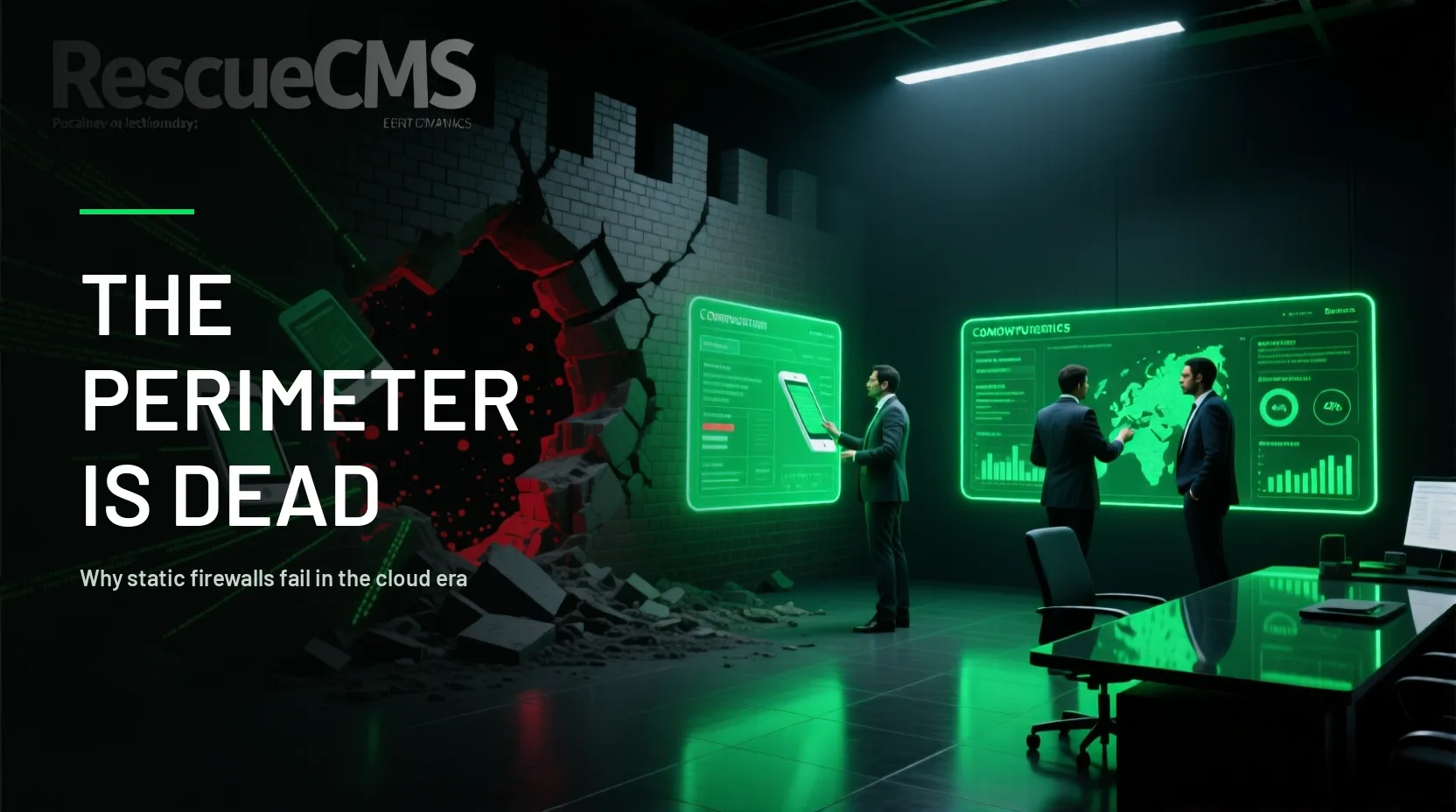
For decades, network security operated under a simple logic: build a strong perimeter (firewall, VPN, network access control) and trust anything already inside it. It worked reasonably well when "inside" meant a physical office with employees using desktop computers connected to a controlled network. That model collapses in a world of remote work, mobile devices, cloud services, and employees accessing corporate systems from networks the company never controlled. Zero Trust is the response to that collapse: a security model that assumes no automatic trust for anything, regardless of whether access comes from "inside" or "outside" a perimeter that, in practice, barely exists anymore.
The Central Principle: Never Trust, Always Verify
Zero Trust's premise is direct: no user, device, or system receives automatic trust just for being in a specific network location. Every access request gets verified independently, regardless of whether it comes from an employee connected from the office or from home, and regardless of whether they already accessed successfully five minutes ago. Trust isn't a permanent state granted once — it's something continuously re-evaluated.
Why the Traditional Perimeter Model Isn't Enough Anymore
The perimeter model assumes an attacker who gets into the network has to overcome additional defenses to move within it — but in practice, once an attacker compromises a single entry point (often through phishing or stolen credentials), lateral movement within a network with traditional perimeter trust tends to be surprisingly easy, precisely because the model assumes anything "inside" the perimeter is already trustworthy.
This connects directly to the pattern we describe in our guide on ransomware-as-a-service — initial access is usually just the first step; what determines the real scope of the damage is how easy it is to move after that initial access.
The Practical Components of a Zero Trust Architecture
Robust identity verification for every access, combining multi-factor authentication with contextual assessment (location, device, usual behavior) before granting access to any resource.
Granular network segmentation, so that access to one system doesn't automatically grant visibility or access to others — the same segmentation principle we cover in our guide on OT cybersecurity in manufacturing, now applied at the company's overall architecture level.
Least-privilege access, granting each user and system exactly the access level needed for their function, no more, reviewed and adjusted periodically instead of accumulating indefinitely over time.
Continuous behavior monitoring, able to detect anomalous activity even from legitimate credentials — an unusual access pattern can indicate a compromised account even when the initial authentication was correct.
Verifying the device's security posture, not just the user's identity, ensuring the device access is coming from meets minimum security standards (updates, encryption, basic controls) before granting access.
How to Start Implementing It Without Halting Operations
Zero Trust isn't a product you install overnight — it's an architecture built progressively. The most practical starting point is usually implementing robust multi-factor authentication on all critical access, followed by basic network segmentation that limits lateral movement, then gradually moving toward more sophisticated contextual verification as the organization matures its monitoring capability.
Frequently asked questions
Does Zero Trust mean I no longer need a firewall or VPN?
It doesn't eliminate them entirely, but it changes their role. They're no longer the single line of defense assumed impenetrable — they become one more layer within a model that continuously verifies, not just at the entry point.
How long does it take to implement a full Zero Trust architecture?
It varies enormously based on the size and complexity of existing infrastructure, but it's a process of months to years, not weeks — which is why the progressive approach, starting with the highest-impact controls, is more realistic than attempting a complete transformation at once.
Is Zero Trust only for large companies?
No. The core principles — robust verification, segmentation, least privilege — are applicable and valuable for businesses of any size, though the sophistication of implementation can be adjusted to available resources.
How does Zero Trust relate to remote work?
It's directly linked. Zero Trust emerged largely as a response to the reality that employees no longer access exclusively from a controlled office network, making the traditional perimeter trust model insufficient for effectively protecting remote access.
Let's talk
Zero Trust represents as much a mindset shift as a technical one. At T.I. RESCUE we help businesses design and implement this architecture progressively through our infrastructure and cybersecurity consulting services. Does your business still rely solely on a perimeter security model? Let's talk.
Contact usSet this site as a preferred source on Google
You may also like



Comments (0)
Be the first to comment.