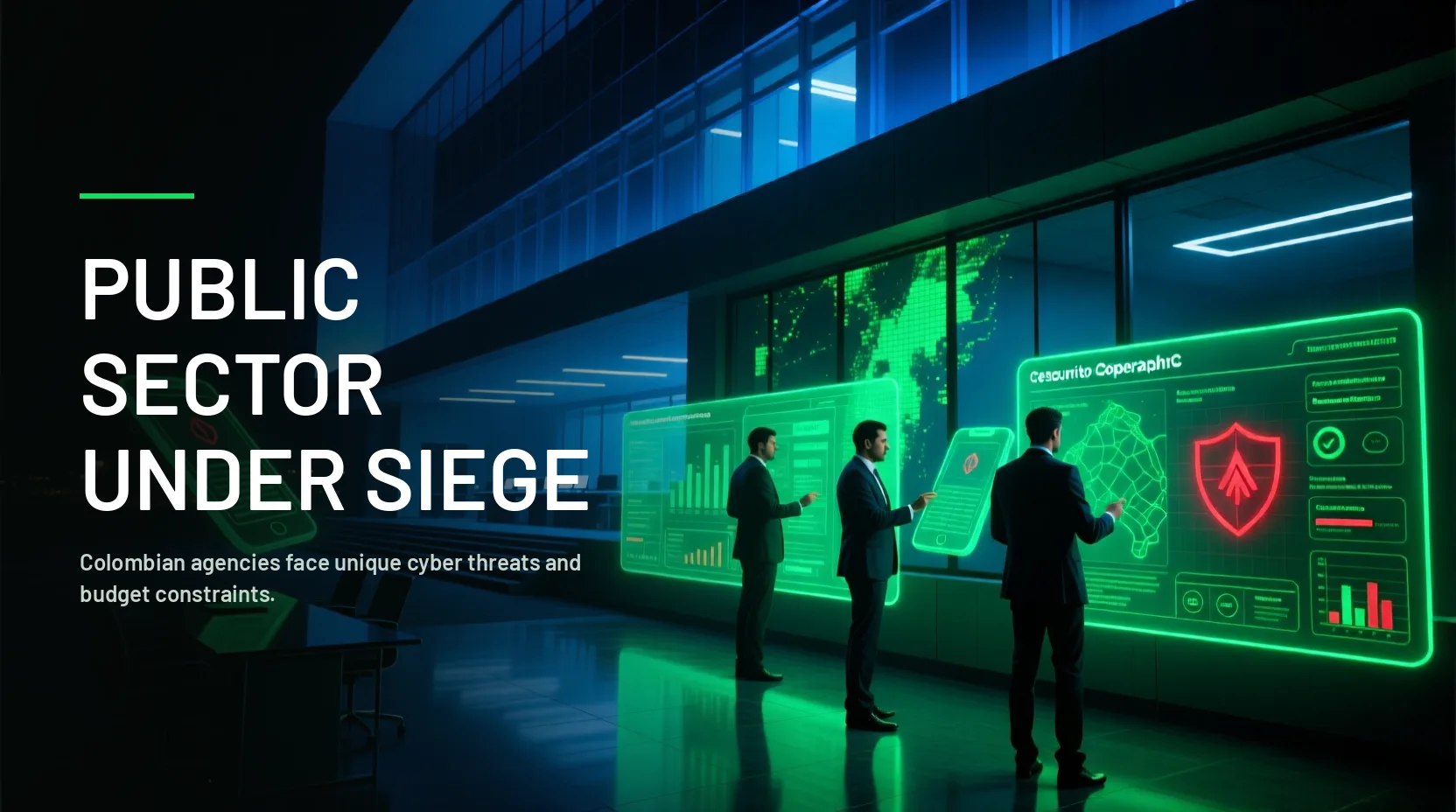
Colombian public entities face a combination of pressures rarely seen together in the private sector: they handle information for millions of citizens, operate under budgets set by cycles that don't always adjust at the speed an emerging threat demands, and are a constant target precisely because of the critical, public nature of the services they provide. CONPES 3995 explicitly identified this tension as part of the national digital trust strategy, but translating that strategy into real protection within each entity remains a considerable challenge.
Why the Public Sector Is Such a Constant Target
A government agency combines several factors that make it attractive to different types of attackers: massive databases of citizen information with resale value in underground markets, systems that often combine modern infrastructure with components inherited from years or decades ago, and — in some cases — motivations beyond direct financial gain, including actors with political or destabilization interests who see public entities as symbolic targets.
The Structural Challenges That Complicate Protection
Rigid budget cycles that don't always allow responding at the speed an emerging threat demands — a critical vulnerability discovered mid-year may have to wait for the next budget cycle to secure the necessary remediation resources.
Decades-old legacy systems, which in many cases remain functionally necessary but no longer receive active security support from the original manufacturer, similar to the challenge we describe in our guide on legacy OT systems in manufacturing.
High technical staff turnover, partly due to salary differences with the private sector, which makes it hard to maintain institutional knowledge continuity about existing security infrastructure.
Public procurement processes that, while necessary for transparency, can slow down acquiring security solutions relative to how fast threats evolve.
What a Realistic Strategy Looks Like Within These Constraints
Prioritization based on criticality and citizen impact, concentrating limited resources on the systems handling the most sensitive information or providing the most critical services, instead of attempting uniform protection that's impossible to sustain with the available budget.
Active collaboration with ColCERT and other national cybersecurity coordination entities, leveraging resources and early warnings an individual entity couldn't generate on its own.
Strict segmentation between critical systems and legacy systems that can't be updated immediately, limiting the risk that a vulnerability in an old system compromises the modern infrastructure connected to it.
Continuous staff training, recognizing that high turnover demands recurring training programs, not one-time sessions that become obsolete once trained staff leave the entity.
Contracting specialized external services for functions where maintaining full-time internal capacity isn't budgetarily viable, like continuous monitoring or incident response.
Public Procurement Requirements as a Lever for Improvement
As we explore in our guide on cybersecurity and public procurement, public sector entities increasingly demand security evidence from their own technology vendors — a requirement that, applied consistently, gradually raises the security standard across the entire vendor ecosystem working with the state, even when the entity itself faces internal budget limitations.
Frequently asked questions
Why do public entities seem more vulnerable than private companies?
They're not necessarily more vulnerable in absolute terms, but they face structural constraints (budget, turnover, legacy systems) that make as agile a response as a private company with more resource flexibility harder to achieve.
What can a small entity with a very limited budget do?
Prioritize the highest-impact, lowest-cost controls, similar to the strategy we recommend for startups: multi-factor authentication, access management, and verified backups before considering larger investments.
Does ColCERT directly help individual entities?
ColCERT operates mainly as a national coordinator for threat response and intelligence, which indirectly benefits individual entities through early warnings and coordination, though implementing controls remains each entity's responsibility.
How does an incident at a public entity affect citizens?
It can expose personal data for millions of citizens simultaneously, disrupt essential public services, and generate the same reporting obligations under Law 1581 as any other organization handling personal data.
Let's talk
Public entities face real structural challenges, but that doesn't eliminate the need for effective protection. At T.I. RESCUE we help government agencies prioritize realistic controls within their specific constraints. Does your entity need to assess how to prioritize its cybersecurity with limited resources? Let's talk.
Contact usSet this site as a preferred source on Google
You may also like

Comments (0)
Be the first to comment.