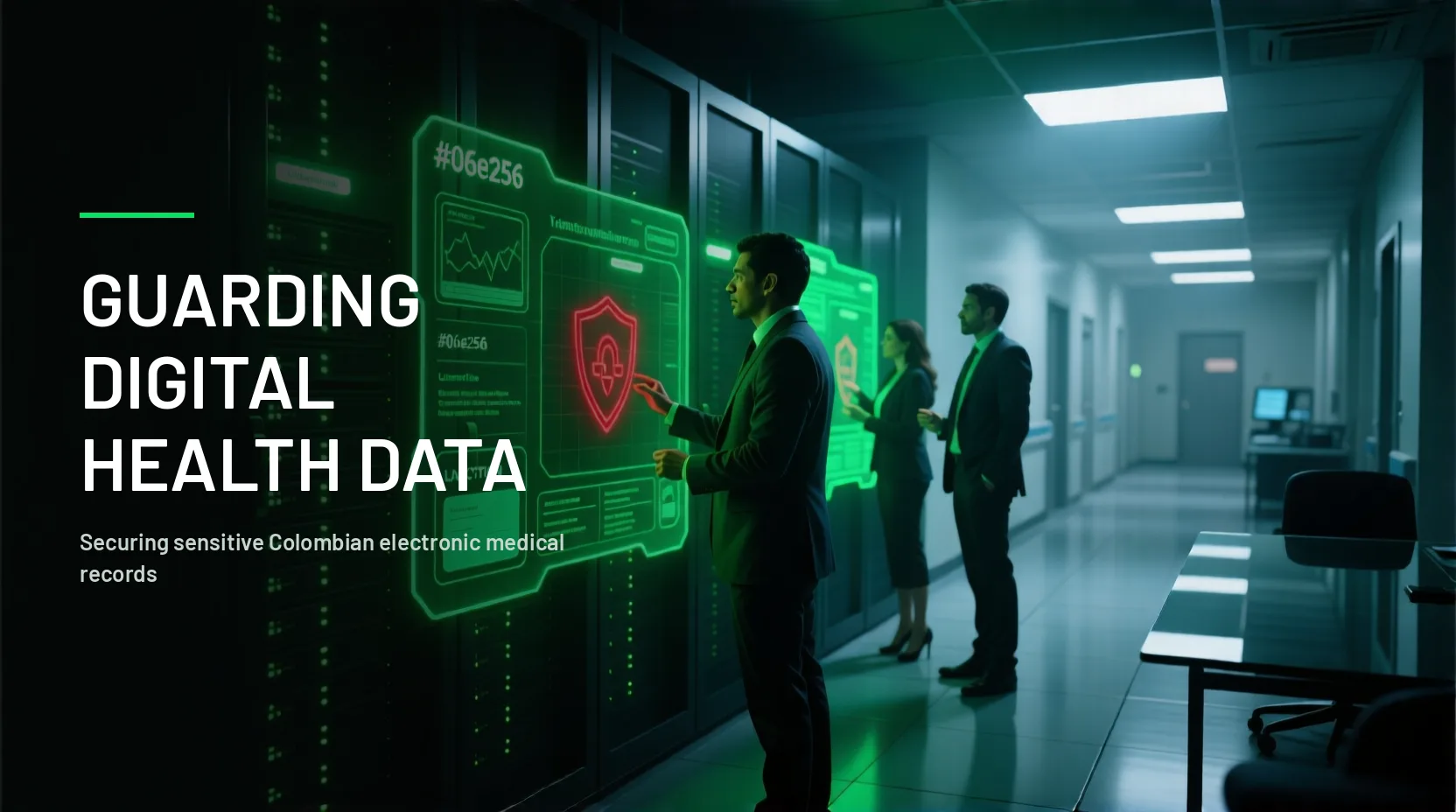
We already explored why ransomware targets hospitals more often than almost any other sector and what Resolution 1644 of 2026 requires for telemedicine security. This guide focuses on the central component of that protection: the electronic medical record, the most sensitive and most attacked asset within any Colombian healthcare operator.

Anatomy of the attack described in the article.
Why the Electronic Medical Record Is Such a Valuable Target
Unlike a credit card number, which can be cancelled and replaced in minutes, a medical record can't be "changed" once exposed. It contains diagnoses, treatments, genetic information in some cases, and psychiatric history — permanent data about the person that, in the wrong hands, carries direct extortion value against the patient in addition to resale value in underground medical data markets, which often pay more for complete medical records than for equivalent financial data.
The Most Common Attack Vectors Against Medical Record Systems
Ransomware targeting the operator's entire infrastructure, encrypting not just administrative systems but clinical systems themselves, generating the operational pressure we describe in our guide on ransomware in hospitals.
Improper internal access, where staff with legitimate credentials look up medical records outside their direct need related to patient care — a risk Law 1581 treats with particular severity given that health information is sensitive data.
Vulnerabilities in integrated third-party systems, like telemedicine platforms, external labs, or billing systems connected to the main medical record system, which expand the attack surface beyond the operator's direct control.
Unpatched connected medical devices, which often share a network with medical record systems without proper segmentation, becoming an indirect entry point.
Specific Controls to Protect the Electronic Medical Record
Access control based on the need-to-know principle, where the system technically limits which records each user can view based on their role and direct relationship to the patient — not just through written policy, but through the system's real technical configuration.
Immutable audit logging of every access, capable of showing exactly who looked up which record and when, which is both a compliance requirement and an early detection tool for improper access.
Encryption of information at rest and in transit, so that even if an attacker gains access to storage infrastructure, the information remains unreadable without the corresponding keys.
Strict segmentation between the medical record network and other systems, including connected medical devices, minimizing the risk that a compromise at one point spreads to the entire system.
Genuinely isolated backups of the medical record, following the same principle we cover in our guide on immutable backups, given that this information's availability can have direct consequences for patient care.
The Human Component, Just as Critical as the Technical
Medical and administrative healthcare staff, naturally focused on clinical care rather than cybersecurity, need specific and recurring — not generic — training on phishing targeting healthcare, proper handling of medical-record-system access credentials, and recognizing social engineering attempts that exploit the hospital environment's constant sense of urgency.
How to Assess the Real Maturity of Current Protection
A cybersecurity audit focused specifically on electronic medical record systems — assessing access control, segmentation, encryption, and continuity capability — reveals gaps rarely visible in a purely documentation-based compliance review.
Frequently asked questions
Is the cloud safe for storing electronic medical records?
It can be, as long as the provider meets appropriate security standards and the healthcare operator correctly configures encryption, access controls, and segmentation — the cloud itself isn't insecure, but a poor configuration is.
What's the difference between protecting electronic medical records and other personal data?
Health information is classified as sensitive data under Colombian law, requiring a higher protection standard than ordinary personal data, in addition to the specific continuity requirements Supersalud imposes.
Do connected medical devices represent a real cybersecurity risk?
Yes, especially when they don't receive regular security updates and share an unsegmented network with other critical systems — they're a frequently underestimated attack vector in the sector.
How often should an electronic medical record system be audited?
Given the sensitivity of the information and how frequently healthcare is targeted, an annual audit is the reasonable minimum, complemented with continuous monitoring between formal audits.

Controls and monitoring that stop the attack.
Let's talk
The electronic medical record demands a level of protection that goes beyond the standard security measures of any other industry. At T.I. RESCUE we work with healthcare operators on cybersecurity audits focused specifically on these critical systems. Has your healthcare institution thoroughly assessed the security of its electronic medical record? Let's talk.
Contact usYou may also like


Comments (0)
Be the first to comment.