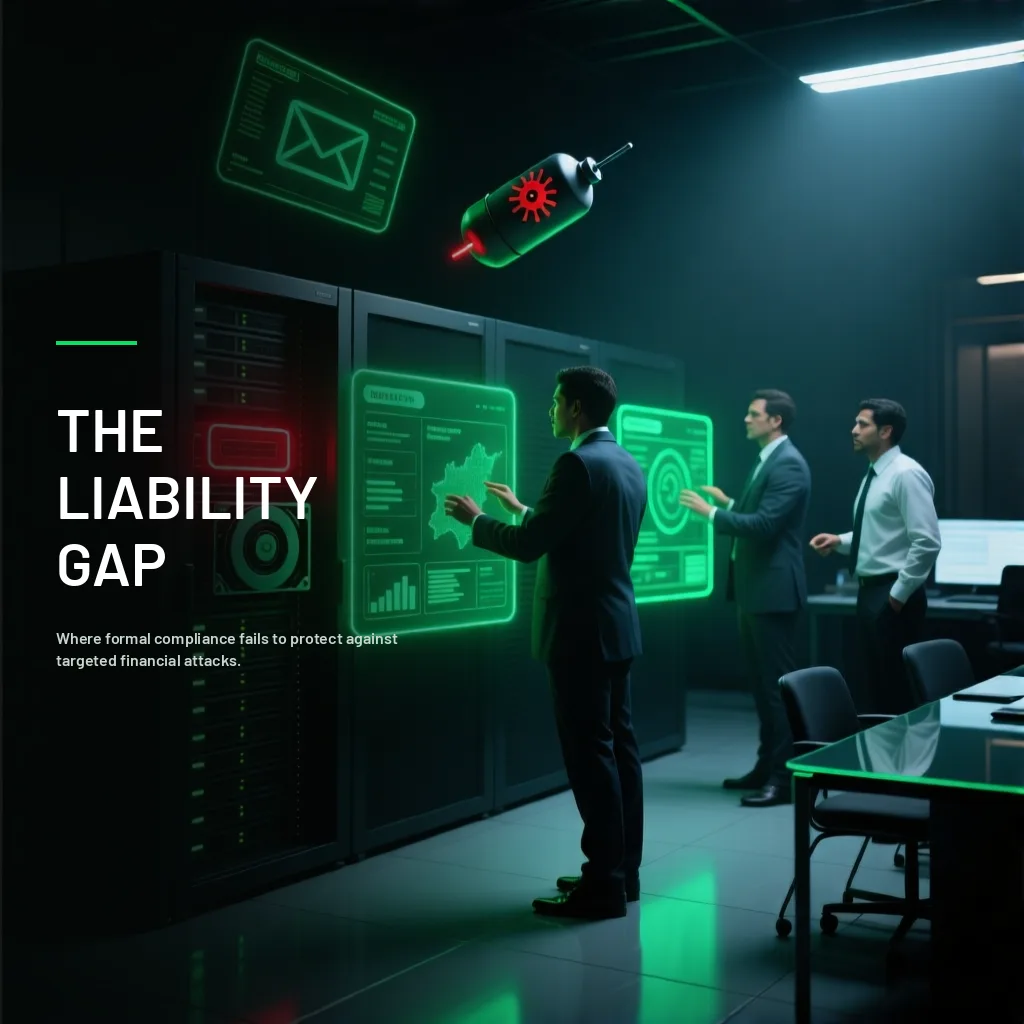
No other industry in Colombia combines as much regulatory exposure, as much volume of targeted attacks, and as much direct legal liability toward the customer as the financial sector. We already covered in detail what SFC Circular 007 formally requires; this guide focuses on the other half of the equation: what that means in terms of real threats and concrete controls for an entity operating in this sector day to day.
The Sector's Specific Threat Landscape
Colombia's financial sector faces a particular combination of threats rarely seen with the same intensity in other industries. Phishing impersonating banks remains the most common entry vector into customer fraud. SIM swapping and vishing target end-user accounts directly, leaning on the bank's own authentication infrastructure. And CEO fraud / BEC represents a considerable internal risk, given the volume of transfers any financial entity handles daily.
Why Legal Liability Changes the Security Investment Calculus
Colombia's Supreme Court has ruled that financial entities carry strict liability for electronic fraud — they must compensate victims unless they can prove the user was solely at fault. This means cybersecurity investment for a financial entity isn't just about reducing operational risk; it's about direct financial exposure for every fraud case the entity fails to prevent or detect in time.
Controls That Go Beyond the Regulatory Minimum
Complying with Circular 007 to the letter sets a floor, not a ceiling. Entities that manage their real risk best tend to implement additional layers:
Real-time transactional behavior monitoring, capable of detecting unusual patterns (amounts, timing, locations) before the transaction completes, not just after.
Adaptive authentication, which adjusts the required verification level based on the calculated risk of each specific transaction, instead of applying the same standard to every operation regardless of its risk profile.
Strict segmentation between customer-facing systems and critical internal systems, so a compromise in a digital service channel doesn't automatically translate into access to core systems.
Awareness programs aimed specifically at customers, not just employees — actively educating on the phishing, vishing, and SIM swapping tactics attackers specifically use against financial-sector users.
Penetration testing more frequent than the expected annual minimum, especially after any significant change to digital infrastructure or the launch of a new channel.
The Particular Challenge for Fintechs
Fintechs operating under the SFC's supervisory perimeter face an additional tension: growing fast while meeting regulatory requirements originally designed with larger, traditional bank structures in mind. The key is usually building security controls into the architecture from the start, not as a layer added after the product is already in production — retrofitting security onto an already-built platform is considerably more costly and complex.
How to Assess Whether Your Entity Is Really Prepared
A cybersecurity audit focused specifically on the financial sector's threat vectors — not a generic audit — is the most reliable starting point for understanding the real gap between what regulation requires and what actually protects the entity and its customers.
Frequently asked questions
What's the difference between complying with Circular 007 and actually being protected?
Complying with the circular is a documentation and minimum-controls requirement; being actually protected requires technically validating those controls work against the real attack tactics the sector faces — something only confirmed through active technical testing, not documentation.
Do small fintechs need the same controls as a large bank?
The level of rigor can be adjusted to size and risk profile, but the fundamental controls — robust authentication, transactional monitoring, segmentation — apply regardless of entity size.
How does this relate to strict liability for electronic fraud?
The more robust and documented an entity's security controls are, the greater its ability to demonstrate it acted with due diligence in a fraud dispute case, which directly influences the liability determination.
How often should a financial entity's cybersecurity strategy be updated?
It should be reviewed continuously, not on fixed annual cycles, since both threats and regulatory expectations in this sector evolve faster than in most industries.
Let's talk
The financial sector has no room to treat cybersecurity as an isolated compliance project. At T.I. RESCUE we work with financial entities on cybersecurity audits and consulting designed specifically for this sector. Does your entity want to go beyond the regulatory minimum? Let's talk.
Contact usYou may also like


Comments (0)
Be the first to comment.