There is a simple way to understand an AI stack: as a human body. The language model is the brain, RAG is the brain with a library, MCP is the nervous system, skills are muscle memory and the agent is the brain with hands. The analogy works, but it is missing one organ, the one behind almost every incident we see in our AI audits: the immune system. Most companies build the first two layers and stop. The ones that keep going plug in tools and automate actions with nothing in place to detect, isolate or stop an attack. This article walks the five layers, the typical weak spot of each according to the OWASP Top 10 for LLM Applications 2026, and the check-up worth doing before building further.
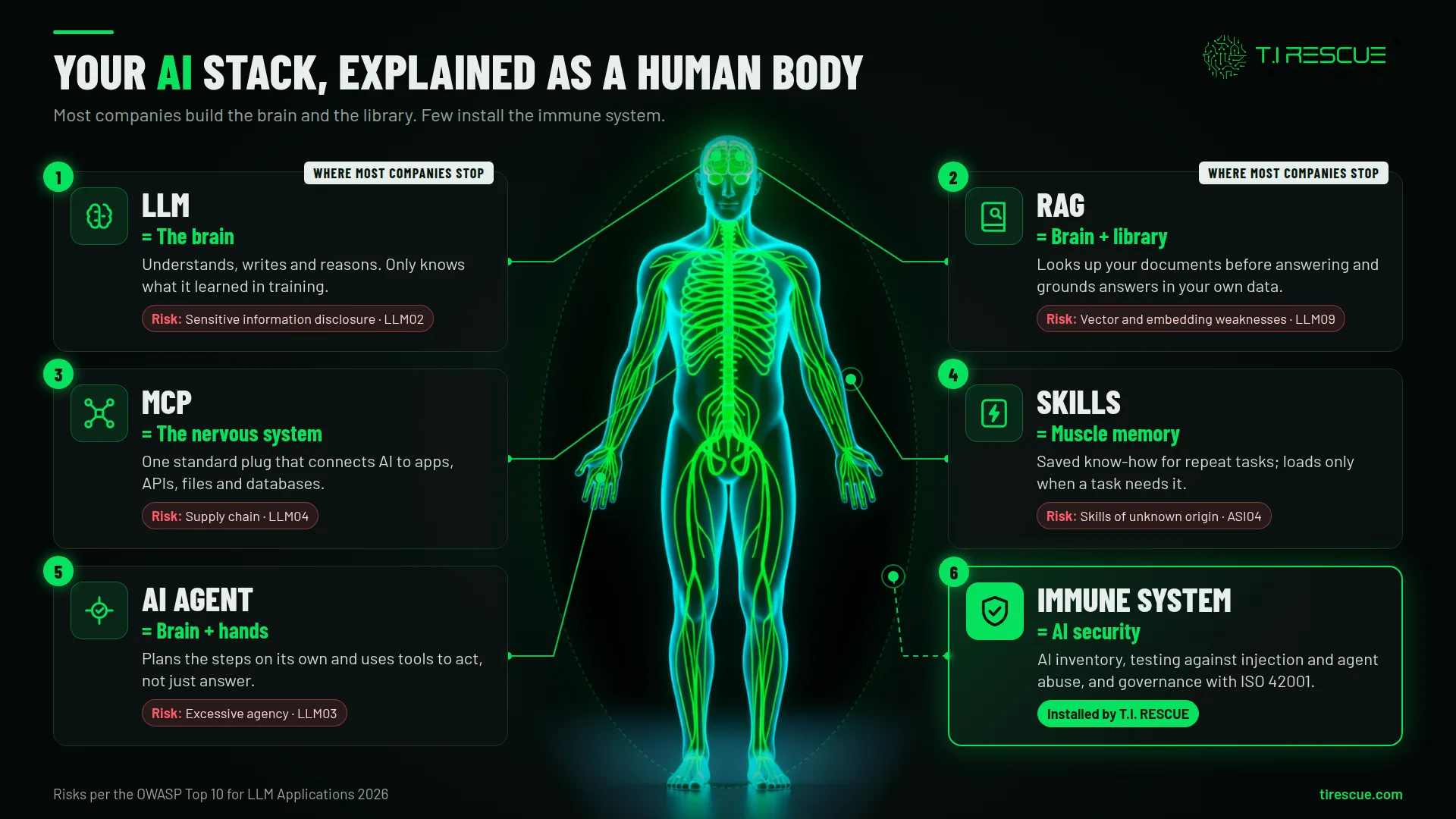
LLM, RAG, MCP, skills and agents as organs, with the OWASP 2026 risk of each layer; the immune system is AI security.
1. LLM, the brain: understands, writes and reasons
The language model only knows what it learned in training and what you put in its context. It is where almost every company starts: an assistant to draft, summarize or answer questions.
2. RAG, the brain with a library: answers from your documents
Retrieval-augmented generation (RAG) looks up your documents before answering and grounds the answer in your own data. It is the natural second step and, for many companies, the last one.
3. MCP, the nervous system: one plug for tools and data
The Model Context Protocol (MCP) is an open standard for connecting AI applications to files, databases, APIs and tools; its authors describe it as the USB-C port for AI. This is where the stack stops merely answering and starts touching real systems.
4. Skills, muscle memory: saved know-how
A skill is a folder with an instructions file that the agent loads only when a task needs it; it is an open format already adopted by several products. It is convenient: repeated know-how is packaged and versioned.
5. AI agent, the brain with hands: plans and acts
The agent plans the steps and uses tools to act, not just to answer. It sends email, opens tickets, changes records and runs commands. It is the layer with the most value and the most consequences.
The missing organ: the immune system

Anatomy of the attack described in the article.
A body with a brain, a library, nerves, muscle memory and hands, but no immune system, does not survive the first infection. In AI the immune system is AI security and governance: knowing which AI exists in the company, what each layer can touch, testing it in a controlled way and having rules and owners. The fact that excessive agency climbed to third place in the OWASP Top 10 2026 says a lot about where incidents are heading. This is how T.I. RESCUE covers it:
Where to start?
AI stack security frequently asked questions
What is an AI stack?
It is the set of layers a company uses artificial intelligence through: the language model (LLM), document retrieval (RAG), connectors to tools and data (MCP), skills with reusable instructions, and agents that plan and act.
Why is LLM + RAG not enough?
Because it solves answering with your own data, but it does not govern who accesses what, does not test the application against attacks and does not prepare the company for the next layer, agents acting with real permissions.
What is MCP and why is it a risk?
The Model Context Protocol is an open standard for connecting AI to files, databases and APIs. The risk lies in MCP servers of doubtful origin or with excessive credentials: the OWASP Top 10 2026 documents database dumps and email theft.
What is excessive agency?
It is OWASP risk LLM03:2026: an agent with more functions, permissions or autonomy than the task needs, which acts on behalf of the company when it receives a malicious instruction.
How does T.I. RESCUE help?
With inventory and classification of the AI in use, technical tests against assistants and agents based on OWASP, and governance with ISO 42001 and NIST AI RMF, from a one-off audit to support on the way to certification.
Sources
- OWASP GenAI Security Project. OWASP Top 10 for LLM Applications 2026. 2026 https://genai.owasp.org/llm-top-10/
- OWASP GenAI Security Project. OWASP Top 10 for Agentic Applications 2026. 2025 https://genai.owasp.org/resource/owasp-top-10-for-agentic-applications-for-2026/
- Model Context Protocol. What is MCP and security best practices. 2026 https://modelcontextprotocol.io/
- Agent Skills. Agent Skills overview and specification. 2026 https://agentskills.io/
Controls and monitoring that stop the attack.
Does your AI already have hands? Ask for a check-up of your stack
Inventory, controlled tests against assistants and agents, and governance with ISO 42001. A prioritized report, without stopping operations.
See the AI auditYou may also like



Comments (0)
Be the first to comment.