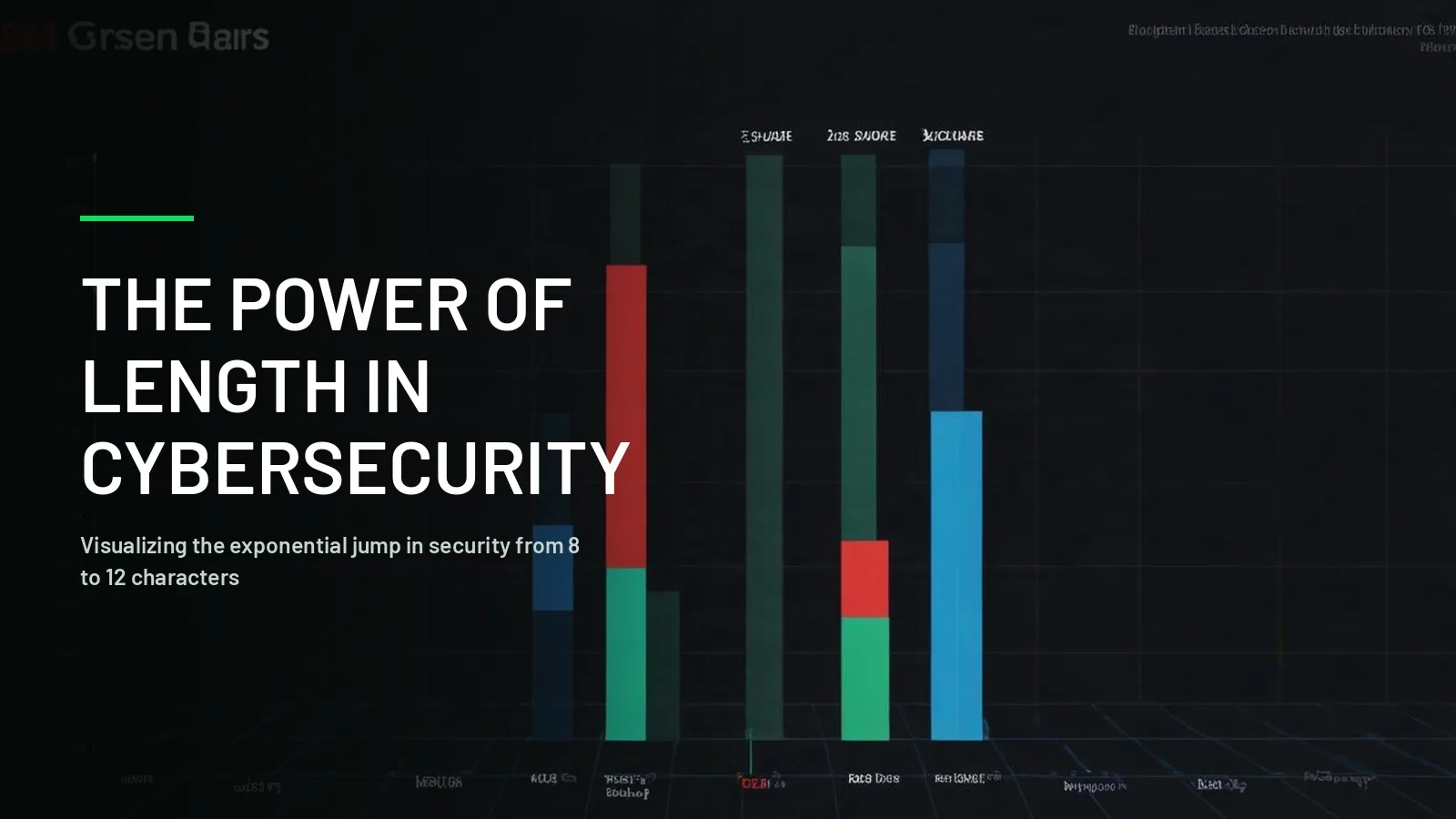
A password of 8 to 12 characters is the minimum standard for basic security, but length is the single most important factor in resisting brute-force attacks. While complexity adds some protection, increasing the character count exponentially raises the difficulty for automated cracking tools. For small and medium businesses, moving from 8 to 12 characters significantly reduces the risk of credential compromise without requiring complex memorization techniques.
Anatomy of the attack described in the article.
Why does password length matter more than symbols?
The computational effort required to crack a password grows exponentially with each added character. An 8-character password using only lowercase letters has 208 trillion possible combinations, while a 12-character password with mixed case and numbers exceeds 10 quintillion. Attackers use GPU clusters that can test billions of guesses per second; therefore, a 12-character password can take centuries to crack, whereas an 8-character one might fall in minutes. This is why security experts recommend prioritizing length over obscure symbols.
What are examples of strong vs. weak passwords?
How to create memorable 12-character passwords?
Use the passphrase method: pick three to four random, unrelated words and add numbers or symbols to break patterns. For example, 'Guitar!River!42' is 13 characters, easy to recall, and resistant to dictionary attacks. Avoid personal data like birthdays, names, or pet names, as these are the first targets of social engineering. If you use a password manager, you can generate fully random 16-character strings for each account, which is the gold standard for security.
What are the best practices for team password management?
Implement a company-wide policy that enforces a minimum of 12 characters and prohibits common dictionary words. Deploy a password manager for staff to store and auto-fill credentials securely, eliminating the need to write passwords on sticky notes. Enable Multi-Factor Authentication (MFA) for all critical services, especially email and cloud storage. Regularly audit access rights and remove credentials for former employees immediately. You can use the free 'Password generator and strength checker' tool from T.I. RESCUE to verify if your current passwords meet these standards before updating your internal policies.
Frequently asked questions
Is 12 characters enough for a secure password?
Yes, 12 characters with mixed case and symbols are generally considered secure for most business applications, though 16 or more is better for high-value targets.
Should I use a password manager?
Absolutely. It allows you to use unique, complex passwords for every account without needing to memorize them, reducing human error.
What is the weakest 8-character password?
'12345678' and 'password' are consistently the most compromised and weakest 8-character passwords globally.
How often should I change my passwords?
Change them immediately if a breach is suspected. Regular forced rotation is no longer recommended by NIST, as it leads to weaker, predictable patterns.
Does using symbols make a password stronger?
It increases the character pool size, but length is the primary driver of security. A long alphanumeric password is often stronger than a short one with many symbols.
Length is the new complexity: the more characters you add, the longer an attacker waits.
Fuentes
- NIST. SP 800-63B: Digital Identity Guidelines: Authentication and Lifecycle Management. 2024 https://nvlpubs.nist.gov/nistpubs/SpecialPublications/NIST.SP.800-63B.pdf
- Verizon. Data Breach Investigations Report. 2024 https://www.verizon.com/business/resources/reports/dbir/
Controls and monitoring that stop the attack.
Secure Your Business with T.I. RESCUE
T.I. RESCUE, a cybersecurity firm based in Medellín, Colombia, provides the tools and expertise to help your team build a robust password strategy.
Hablar con un especialistaSet this site as a preferred source on Google
You may also like
Comments (0)
Be the first to comment.