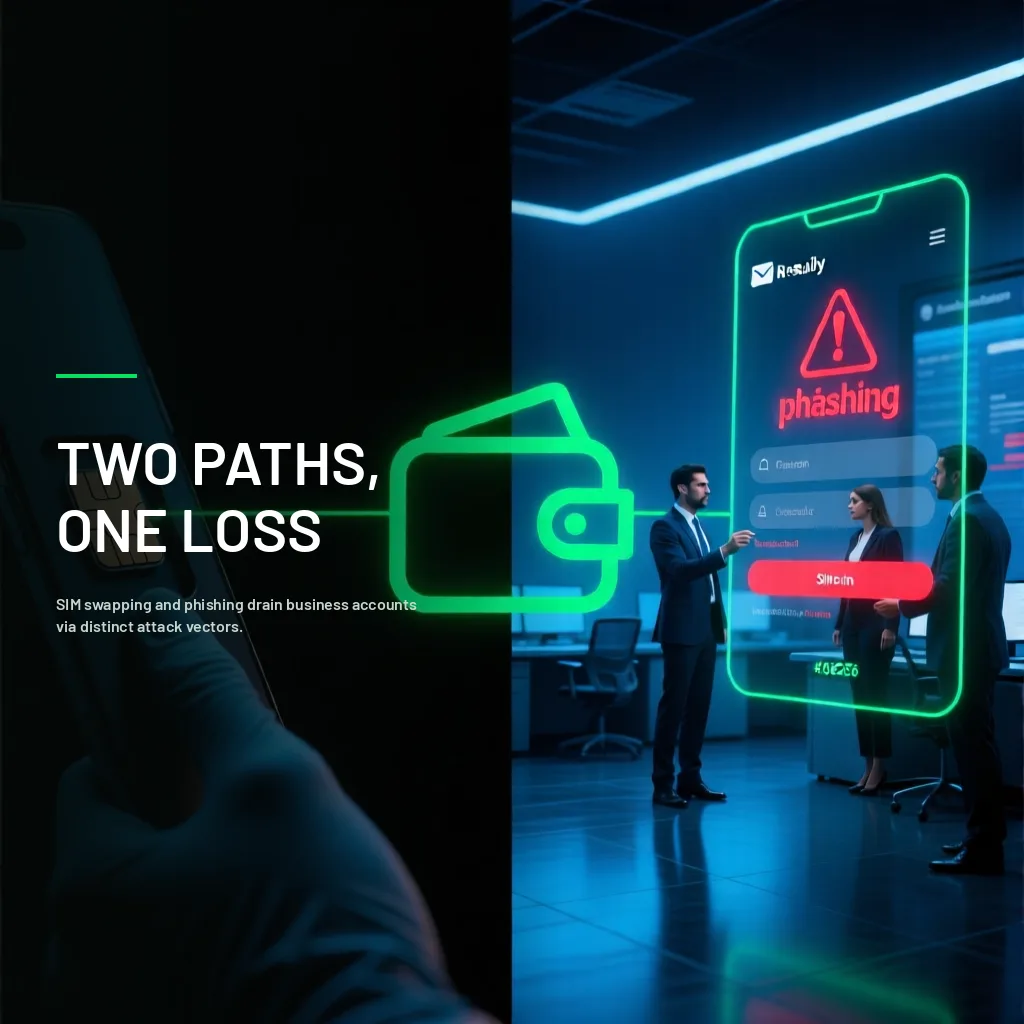
Both end up in the same place — a drained account, compromised credentials, money that disappears — but they get there through completely different paths. SIM swapping takes control of the victim's phone line away from them; banking phishing steals credentials directly without touching the phone at all. Understanding the difference matters, because effective defenses against one don't necessarily work against the other.
How Each One Works
SIM swapping, which we've already covered in detail, requires the attacker to trick the mobile carrier into transferring the victim's line to a SIM card under their control — using social engineering with previously gathered personal data, or through physical theft of the phone combined with a default PIN that was never changed. Once achieved, the attacker receives all of the victim's verification SMS messages, including the one-time codes many banks and digital wallets use as a second authentication factor.
Banking phishing, on the other hand, doesn't need to touch anything related to the phone line. It just needs to trick the victim into entering their credentials — username and password, sometimes even the verification code — directly into a fake page mimicking the real bank's interface, following the patterns we describe in our guide on phishing in Colombia.
The Differences That Actually Matter
Operational complexity. SIM swapping requires several coordinated steps — data gathering, social engineering with the carrier, and often additional technology like deepfakes to bypass biometric verification. Banking phishing, in its most basic form, only needs a convincing email or message and a fake page.
Speed of scale. A phishing attack can go out to thousands of people simultaneously with the same effort. SIM swapping is generally executed against a specific, previously researched target, making it slower to scale but potentially more targeted and effective against that particular victim.
Visible warning signs. A SIM swapping victim usually notices a clear, early sign: the phone suddenly loses signal. A banking phishing victim, on the other hand, may not notice anything until checking for suspicious activity on their account, since the phone keeps working completely normally.
Specific defenses. Protecting against SIM swapping involves strengthening the SIM's PIN, migrating to authentication that doesn't depend on SMS, and considering a switch to eSIM. Protecting against banking phishing mainly involves recognizing the signals we cover in our guide on how to spot a phishing email and never entering credentials outside the official app or directly verified site.
Why They Sometimes Combine
The most sophisticated attacks don't choose between one or the other — they combine them. An attacker might use phishing to obtain an account's initial credentials, then turn to SIM swapping specifically to intercept the SMS verification code protecting that account as a second factor, completing full access. This combination is exactly why SMS-only multi-factor authentication is no longer considered robust enough for high-value accounts.
Which Represents Greater Risk for a Business
For corporate risk specifically, banking phishing tends to represent the more frequent, higher-volume threat — it's the vector behind most of the fraud affecting business transactions. SIM swapping, while less frequent in volume, can be devastating when the target is an employee with access to critical systems or authority to approve transfers, precisely because it usually comes with deeper prior research on the specific victim.
The Defense That Protects Against Both
Regardless of which threat is more relevant to your specific situation, some measures reduce risk against both: using authenticator apps instead of SMS as a second factor, training staff to recognize both vectors, and establishing out-of-band verification processes for any transaction or sensitive data change.
Frequently asked questions
Which of the two is more common in Colombia?
Banking phishing is considerably more frequent in total attempt volume, though SIM swapping has grown notably, especially in fraud related to digital wallets.
Does multi-factor authentication protect against both?
It depends on the type. SMS-based MFA is vulnerable to SIM swapping; authenticator-app-based MFA (like Google Authenticator) doesn't depend on the phone line and offers better protection against both vectors.
How do I know if I'm a victim of SIM swapping versus phishing?
The clearest sign of SIM swapping is sudden loss of phone signal. Banking phishing doesn't affect phone signal; it's usually discovered by checking for unrecognized activity on the account.
Does switching to eSIM completely eliminate SIM swapping risk?
It significantly reduces the risk of the physical variant (phone theft with SIM extraction), but doesn't fully eliminate the social-engineering-based variant against the carrier, which remains possible depending on the mobile carrier's controls.
Let's talk
Understanding which threat you're facing is the first step to defending against it correctly. At T.I. RESCUE we help businesses assess their real exposure to both vectors through our social engineering defense service. Does your business know which of these risks affects it more? Let's talk.
Contact usYou may also like
Comments (0)
Be the first to comment.