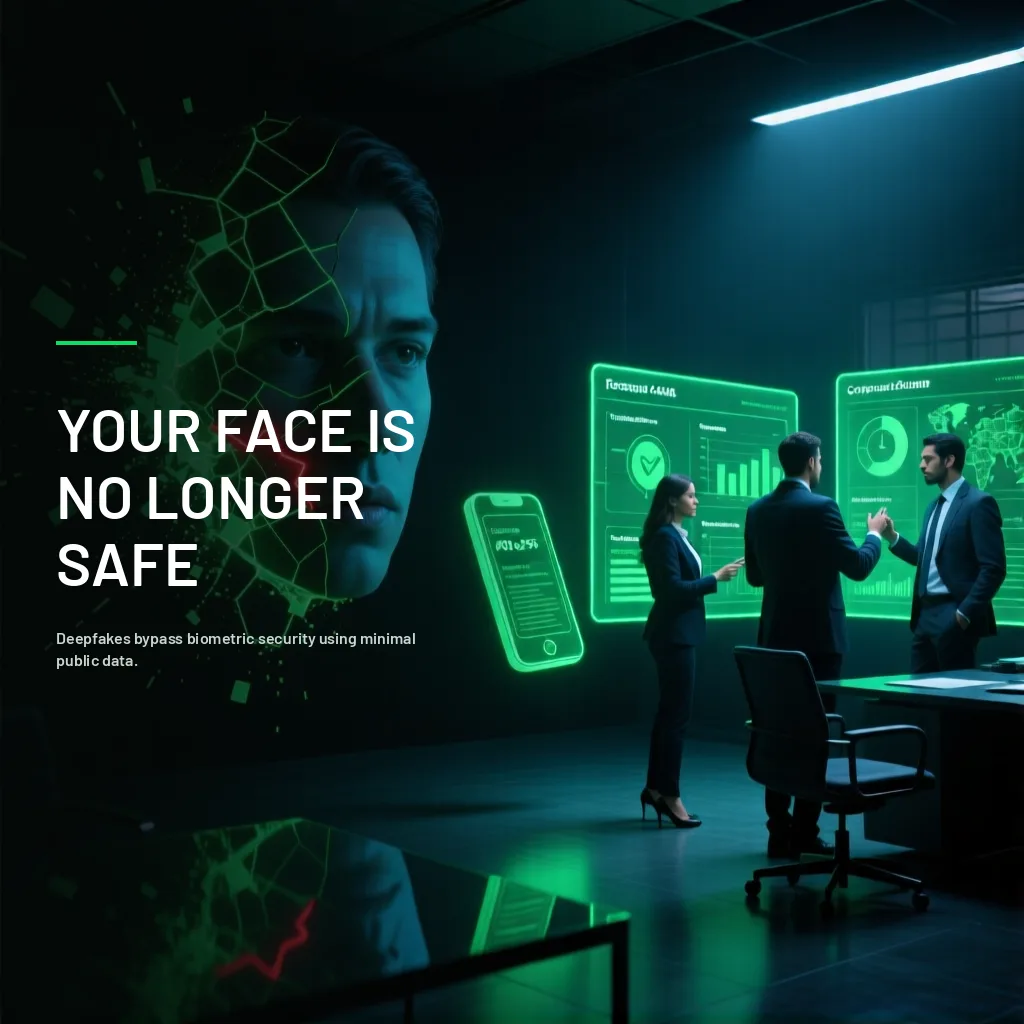
For years, facial recognition and voice verification were sold as the secure future of authentication — something that, unlike a password, couldn't simply be stolen or guessed. That promise isn't as solid anymore. With a handful of social media photos and a few seconds of public audio, today's deepfake technology can generate synthetic video and voice convincing enough to fool both automated identity verification systems and real people on a call.
How the Fraud Actually Works Technically
Deepfakes use AI models trained on real samples of a person's voice or face — the more publicly available samples, the more convincing the synthetic result. An active social media account with enough photos and videos gives an attacker all the material needed to train a model capable of generating new content: videos where the person "says" something they never said, or calls where their cloned voice gives instructions they never gave.
Our guide on SIM Swapping in Colombia already documented how this technology is used specifically to bypass liveness detection systems on digital wallets like Nequi, generating synthetic videos with eye and facial movements that fool biometric verification after the attacker has already taken control of the victim's phone number.
Beyond Fraud Against Individuals: The Business Risk
The same principle applies, with potentially bigger consequences, in a corporate context. A cloned voice of the general manager giving "urgent" instructions over the phone is a direct evolution of CEO fraud — it's no longer just a well-written email, but a call where the voice sounds exactly like the real person, with the inflections and tone an employee would normally recognize instantly.
Documented cases internationally already show businesses that transferred significant amounts after instructions given over video call, where every visible participant except the victim was AI-generated.
Why It's So Hard to Detect
High-quality deepfakes no longer show the obvious visual tells of earlier generations — unnatural blinking, blurry edges around the face, imperfect lip sync. Current models fix most of these flaws, especially in short clips or on lower-quality connections, where imperfections naturally blend into video compression artifacts.
How to Protect Yourself and Your Business
Set up a pre-agreed verification word or phrase with key family members or colleagues, to use for any unusual request for money or sensitive information over a call or video call — something a deepfake couldn't know in advance.
Always verify through a completely different channel than the one the request arrived on. If the instruction comes via video call, confirm by text to an already-known number, or vice versa — never use the same channel the suspicious request arrived through.
Be wary of extreme urgency combined with requests for confidentiality, the same psychological pattern that dominates traditional BEC, now boosted by an additional layer of audiovisual credibility.
Don't rely solely on biometric liveness detection for high-value transactions. Combine it with additional out-of-band verification, especially at businesses handling significant transfers.
At businesses, limit the amount of public audio and video content from executives with financial authority, where reasonably possible, reducing the material available to train a cloning model.
Frequently asked questions
How can I tell if I'm talking to an AI and not the real person?
It's increasingly hard to detect through perception alone. The most reliable strategy isn't trying to "detect" the deepfake in the moment, but verifying through an independent channel before acting on any sensitive request.
Do banks' biometric verification systems already detect deepfakes?
Some institutions are updating their liveness detection systems to identify synthetic content, but it's a constant arms race between generation and detection technology — absolute protection shouldn't be assumed.
Does this type of fraud only affect people with a public social media presence?
The risk is higher for those with more public content available, but anyone with some level of social media or public video/audio presence is technically a possible target.
What do I do if I've already been a victim of deepfake fraud?
Act the same as with any financial fraud: contact your bank immediately to try to stop transactions, document all available evidence, and file a formal complaint citing the applicable criminal categories under Law 1273.
Let's talk
Deepfake technology is advancing faster than public awareness of it — and that's exactly what attackers are exploiting. At T.I. RESCUE we include this kind of emerging threat within our social engineering defense training. Does your finance team know what to do when a voice or video instruction looks legitimate but isn't? Let's talk.
Contact usYou may also like

Comments (0)
Be the first to comment.