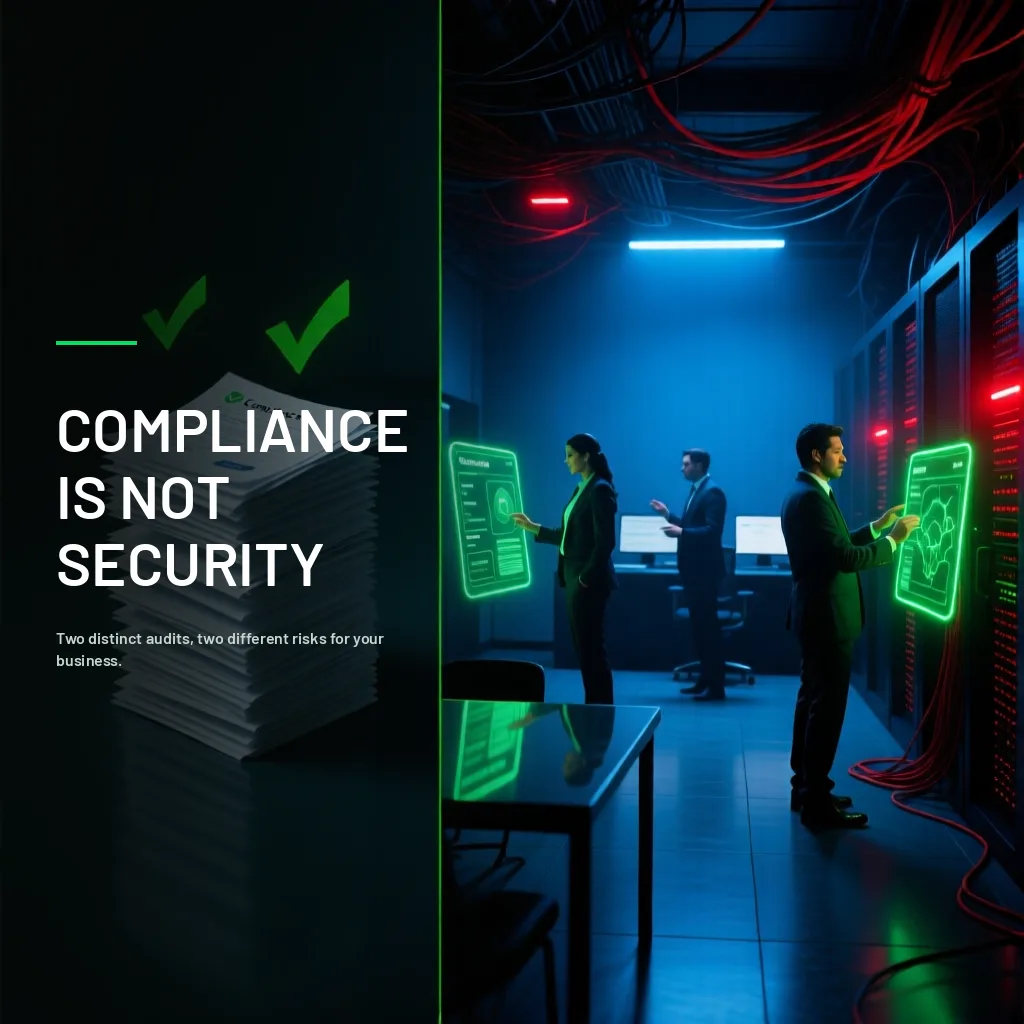
"We already had the audit done, so why do you keep finding vulnerabilities?" It's a question we hear more often than you'd expect, and it almost always reveals the same underlying confusion: the business hired a compliance audit, expecting it to also function as a technical cybersecurity audit. They're two different exercises, answering two different questions, and mixing them up can leave a business with a false sense of security — compliant on paper, technically exposed.

Anatomy of the attack described in the article.
What a Compliance Audit Actually Evaluates
A compliance audit reviews whether your business meets a specific regulatory framework: Colombia's Habeas Data Law, the ISO 27001 standard, SFC Circular 007, or any other applicable regulatory or contractual standard. The core question it answers is: "do we have the policies, processes, and documentation this framework requires?"
This type of audit typically reviews written policies, documented procedures, training evidence, decision records, and generally the formal governance structure around information security. It's fundamentally a documentation and process exercise.
What a Technical Cybersecurity Audit Actually Evaluates
A cybersecurity audit answers a different question: "can our systems actually be attacked and compromised?" Instead of reviewing documents, it examines the real technical infrastructure — networks, applications, configurations, access controls — combining automated analysis with manual review by specialists to identify concrete vulnerabilities an attacker could exploit.
It's entirely possible, and in fact happens more often than anyone would like, for a business to have all its compliance documentation in order and still carry serious technical vulnerabilities. The paperwork says there's an access management process; the technical audit finds a former employee whose credentials have been active for eight months.
Why the Confusion Is So Common
Both audits share vocabulary and, to a point, goals — both aim to reduce organizational risk. It's easy to assume that if one was done, the other is covered too, especially since the buying process for these services doesn't always clearly distinguish between the two types of work. And there's a real commercial incentive behind that confusion: a documentation audit is usually faster and cheaper to deliver than a deep technical audit, so some vendors sell it under a more ambitious name than it actually deserves.
When You Need One, the Other, or Both
If your business is preparing for a specific certification, or needs to demonstrate regulatory compliance to a client or oversight body, a compliance audit is the right starting point.
If what worries you is knowing how exposed your infrastructure actually is to a real attacker, or you just suffered an incident and need to understand how it happened, the technical audit is what actually answers that.
In practice, most businesses that take cybersecurity seriously end up needing both, and this order generally makes the most sense: first understand what the relevant regulatory framework requires, then technically validate that the controls you claim to have actually work. Our guide to the ISO 27001 compliance checklist explains in detail how both processes connect within a formal certification.
How to Tell Them Apart When You Hire
Before signing an audit contract, it's worth asking directly: is the final deliverable a documentation compliance report, or does it include real technical testing of the infrastructure? Does the team performing it hold offensive technical certifications (pentesting, ethical hacking), or mostly compliance management experience? Neither answer is wrong — it depends on what you need — but knowing the difference keeps you from paying for one type of work while expecting the results of the other.
Frequently asked questions
Which should my business do first?
Generally it makes more sense to first understand the applicable compliance framework, then technically validate the controls. But if your business has never done either, an initial cybersecurity audit tends to surface the most urgent risks first.
Does a compliance audit include pentesting?
Not necessarily. Some compliance audits include limited technical testing as part of the evidence a regulatory framework requires, but that's not equivalent to a full technical audit or a dedicated pentest.
How often should I repeat each one?
Compliance audits usually follow a cadence tied to the regulatory framework — annually, in many cases. Technical cybersecurity audits should happen at least as often, and ideally after any significant infrastructure change.
Can I use the same provider for both?
Yes, and it's often more efficient, as long as the provider has real capabilities in both areas — not just one, dressed up under the other's name.

Controls and monitoring that stop the attack.
Let's talk
Understanding this difference avoids one of the most common and costly mistakes in business cybersecurity: thinking you're protected because the paperwork is in order. At T.I. RESCUE we offer both [technical cybersecurity audits](https://tirescue.com/en/auditoria-de-ciberseguridad/) and [compliance consulting](https://tirescue.com/en/consultoria-de-ciberseguridad/), and we help you figure out which one you need first based on your actual situation. Not sure which your business needs? [Let's talk it through together](https://tirescue.com/en/contacto-ti-rescue/).
Contact usYou may also like


Comments (0)
Be the first to comment.